|
In This Issue: |
|
Message from Laura |
|
Feature Article:
Sleep Your Way to a Productive Day! |
|
Educational Resources |
| Time Tips and Traps |
| Ask the Audience |
| Laura's Blog |
| Hot Links |
| Words of Wisdom |
|
Laura in the NEWS |
| Book Laura |
| Where in the World is Laura? |
|
Subscription and Contact Information |
| Reprint Information |
|
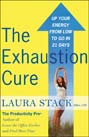 A
holistic approach to increasing your get-up and go, from
the productivity expert whose previous books showed
people how to Find More Time and Leave the
Office Earlier. If you want to be productive
but are just too tired all the time, you need to read
this book! Laura Stack combines invaluable insights and
practical advice in this guide to becoming more
energetic and more productive in every area of life.
Stack describes the factors that contribute to low
energy (the “energy bandits”) and explains how to reduce
their effects and build up or renew sources of positive
force (with “energy boosters”). A
holistic approach to increasing your get-up and go, from
the productivity expert whose previous books showed
people how to Find More Time and Leave the
Office Earlier. If you want to be productive
but are just too tired all the time, you need to read
this book! Laura Stack combines invaluable insights and
practical advice in this guide to becoming more
energetic and more productive in every area of life.
Stack describes the factors that contribute to low
energy (the “energy bandits”) and explains how to reduce
their effects and build up or renew sources of positive
force (with “energy boosters”).
Available now from Amazon.com and at better bookstores everywhere.
|
|
 Find More Time.
You can't add more hours to the day, but Laura will help you make the most of the time you have and get things done.
Available now from Amazon.com. Find More Time.
You can't add more hours to the day, but Laura will help you make the most of the time you have and get things done.
Available now from Amazon.com.
Leave the Office Earlier, 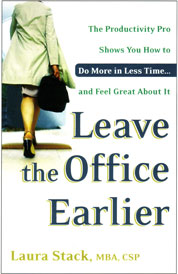 Laura shows you how you CAN get more done than you ever thought possible and still get home to your real life sooner.Available now from Amazon.com. Laura shows you how you CAN get more done than you ever thought possible and still get home to your real life sooner.Available now from Amazon.com.
More of The Productivity Pro's Resources |
|
|
Educational Resources from The
Productivity Pro® |
|
Browse the
Productivity Store for a variety of resources to
improve your personal and professional productivity. |
|
|
Words of Wisdom |
“If you can't sleep, then get up and do something
instead of lying there worrying. It's the worry that
gets you, not the lack of sleep.” —Dale Carnegie
“No day is so bad it can't be fixed with a nap.” —
Carrie Snow
“People who say they sleep like a baby usually don't
have one.” — Leo J. Burke |
|
Where in the World
is Laura? |
|
These
are all private client engagements with Laura Stack. At this time, Laura does
not offer open enrollment seminars to the general public. If you’re interested
in bringing Laura to your organization to present a training seminar for your
employees on the day prior or the day after one of these engagements below,
please contact John Stack for
special “piggyback” pricing.
October
3::Denver, CO
13::Minneapolis, MN
14::St. Cloud, MN
24::Niagara Falls, NY
27::Denver, CO
28::Highlands Ranch, CO
November
11::Denver, CO
13::Denver, CO
18-23::Phoenix, AZ
December
13::Nashville, TN
January 2009
10::Ft. Lauderdale, FL
February 2009
7::Denver, CO
April 2009
15::Overland Park, KS
June 2009
1::Saratoga Springs, NY
Visit Laura's Calendar On-line for her complete availability.
|
|
|
Laura's Blog |
|
Subscribe to feed:
http://blog.theproductivitypro.com
Recent posts:
Best Practices for Scheduling Your Day and Setting Appointments Part I of III
Best Practices for Scheduling Your Day and Setting Appointments Part II of III
Best Practices for Scheduling Your Day and Setting Appointments Part III of III
The 1 List That Every Manager Must Work With by Rosa Say
Are People Who Have Their Dream Jobs More Productive?
Stop Trying to Be on Time!
Getting Rid of Computer Clutter
|
|
|
Hot Links |
|
Bosses keep close watch on those who work
at home
By Cricket News
The clipboard toting, clock-watching, quota-setting
productivity expert, peering nosily over your
shoulder at work, has been out of fashion in business
schools for decades.
New Yorkers Addicted To E-Mail More Than
Most, Offered 12-Step Program
InformationWeek - Manhasset,
NY, USA
"As technology continues to advance, we begin to rely
upon it more and more," Marsha Egan said.
How to Find More Time in Your Life – Take
´The Morning Test´
American Chronicle - Beverly Hills, CA, USA. Dawn and
the girls were in bed. I was tired from a long day at
work. It was almost 10 pm, and I was headed for the
couch.
|
|
|
|
|
Feature Article: |
Sleep Your Way to a Productive Day!
Sometimes I wish I were a bear, so I could hibernate
for six months. Alas, I’m only human. How much sleep do you think the average
adult gets per night? A National Sleep Foundation poll of 1000 adults found that
1/3 get less than 7 hours per night and only 1/3 are getting the recommended 8
hours per night. John Shepard, medical director of the Mayo Clinic Sleep
Disorders Center, says that most adults need between 7 ½ and 8 ½ hours of sleep
per night, teens need 9 hours and 15 minutes, and small children need more.
In 1910, the average adult got nine hours of sleep per night, because without
electricity, people generally went to sleep when darkness fell. Now we just flip
on the lights and keep working. Americans tend to under-sleep by choice, burning
the candle at both ends due to hectic work and family schedules. We believe we
can have more time for work and family by allowing ourselves less time for
sleep. However, many of us do snooze—at work, driving to and from work—in a
state of stupefied sleepiness.
The poll actually also showed that 85% of people would sleep more, if they were
convinced it would contribute to a happier life. Here are some statistics to
convince you:
• The Foundation reported that drowsy workers are costing U.S. employers an
estimated $18 billion annually in lost productivity. If you add in errors,
damage, and health consequences, the costs are even higher.
• Overall, the quality of work, the amount of work, and your concentration EACH
decline by 30% when you’re sleepy.
• A lack of sleep affects your personal life too. Among those having sleep
problems, 77 percent also said they had less marital satisfaction. 38% of
married respondents said they have intimate relations with their spouse less
than once a week because of fatigue and lack of time.
• Studies show that sleepiness impairs memory, reaction time, and alertness.
Tired people are more moody, less patient with others, and less interactive in
relationships.
• Too little sleep also suppresses your immune function, which leads to
increased infection and illnesses.
• Getting inadequate sleep also causes problems similar to drinking too much
alcohol. Nodding off at work isn’t just unproductive; it can be disastrous. The
National Highway Traffic Safety Administration reports that sleepy drivers cause
at least 200,000 crashes each year. The 1989 Exxon Valdez Alaskan oil spill was
reportedly due at least in part to the severe fatigue of the tanker’s
sleep-deprived third mate. The Challenger accident, Chernobyl, and Three Mile
Island accidents were also due to worker fatigue. In rats, prolonged sleep
deprivation resulted in death. (Although we haven’t had any volunteers for that
study in adults yet!)
The bottom line is that sleeping well is not a luxury…it’s a necessity.
The Mayo clinic defines an adequate amount of sleep as whatever produces daytime
alertness and a feeling of well-being. You shouldn’t need an alarm clock to wake
you up if you are getting enough sleep. So let’s test your level of sleep
deprivation!
Answer the following questions “yes” or “no”:
1. Do you get sleepy while at your desk during the day?
2. Do you consistently get grumpy or feel low?
3. Do you need an alarm clock to wake you up in the morning?
4. Do you hit an afternoon “slump” after you eat?
5. If you were a passenger in a car for an hour during the day, would you nod
off if you didn’t take a break?
6. Would you fall asleep if you sat quietly and read during the day?
7. Are you likely to doze off while watching TV during the day?
8. Do you get fewer than six hours of sleep at night?
Total number of “yes” answers: _______
Check your score to see how sleepy you are:
1 - 3 Congratulations, you are getting enough sleep!
4 - 5 You are sleep deprived.
6 and up Seek the advice of a sleep specialist!
If your score is 6 or higher, you might want to consider having your primary
care physician order an oximetry test on you, just to rule out a more serious
problem. If your score is moderate and shows you’re simply not sleeping enough,
here are some ideas to help you sleep better:
Slow your pace. Avoid activities that stimulate you, such as fast video
games, arguing with a spouse, or working out, at least an hour before bedtime,
preferably more. With all its sounds, lights, and color, TV-watching can be
especially stimulating. Yes, you may get drowsy and doze off in front of the
television, but you’ll have to wake again to settle into a sleeping position,
and then experience wakefulness during the night. Your body may be tired, but
your brain waves are very active after watching television. Instead, select
non-stimulating activities such as light reading, ironing, doing dishes, taking
a bath, or writing letters for at least one hour before bedtime.
Clear your mind. Write down everything you’re thinking about that must be
done the next day. Lying in bed awake with all those reminders running through
your head will prevent you from sleeping soundly. If you’re stewing over an
issue with someone, journal or write a draft email but don’t send it. (In fact,
you’re safest not to even put their email address in the “to” field so your
trigger-happy finger doesn’t accidentally go off.) Waiting 24 hours after you’ve
vented on paper will give you a better perspective, and you’ll probably be glad
you put time between your writing and sending that message. The bonus? You were
able to get to sleep.
Train your brain. I read an article about how some babies sleep better
when exposed to the sound of a heartbeat or another “white” noise. I figured it
couldn’t hurt to try it on adults, too. So for Christmas last year, I bought
John a sound machine. He played with the different noises and selected the
“ocean” sound, with waves crashing on the shore. From December 25 until January
3, he played this sound while drifting off to sleep. On January 3, we went on
vacation to Cancun, Mexico, with the family and were lucky enough to get an
Oceanside room. John didn’t even need his sound machine! For someone who doesn’t
usually sleep well in hotels, I was so amazed how deeply and long he slept. He
was always the last one to get up in the morning. I think that Cancun vacation
may well be one of his favorites, simply because he got such great sleep!
Form good sleep habits. When you lie down, can you fall asleep within a
matter of minutes? No? Then you might not have the right mental association to
your bed. When you get in your bed, your brain should tell your body to shut
down and go to sleep. Unfortunately, many people crawl into bed and don’t put
their heads on the pillow. They eat. They watch television. They read. They do
paperwork. They have conversations with their significant other. They worry. As
a result, these associations encourage wakefulness, and the brain soon
disassociates the bed with sleep. When you finally tell it, “Okay, I’m serious
now,” it takes longer to get the message. Only use your bed for sleeping and
intimate relations with your significant other. Eating, watching television,
reading, working on your computer, and any other activity should be done out of
bed, preferably in a completely different room. Your bedroom should be your
sleeping sanctuary—a place where your mind automatically goes to sleep. You’re
better off doing something relaxing an hour before bedtime, such as a warm bath,
aromatherapy, knitting, petting your cat, doing dishes, or reading. If you wake
up during the night and don’t fall back to sleep in 15 minutes, get up. Write
down everything you’re thinking about. Then try to sleep again 15 minutes later.
If don’t get up, over time your body will adjust to tossing and turning instead
of sleeping.
Eat and drink to sleep. Elizabeth L. Vliet, M.D., author of It’s my
Ovaries, Stupid! says to take 200 to 400 mg of magnesium and 500 mg of calcium
thirty to sixty minutes before bedtime to help your body prepare for sleep.
“Studies show that your brain needs adequate levels of these vitamins, along
with optimal levels of estradiol, in order to regular sleep,” says Vliet. Avoid
eating a large meal just before bedtime; however, don’t go to bed ravenous—it’s
about balance—have a light snack if you must. Breus says “milk, tuna, halibut,
pumpkin, artichokes, avocados, almonds, eggs, peaches, walnuts, apricots, oats,
asparagus, potatoes, and bananas” all promote good sleep. Also watch the alcohol
before bedtime. Alcohol can indeed make you sleepy, but it is considered a
stimulant and will cause wakeful sleep, nightmares, sweats, and headaches as
your body clears it from your system. Try warm milk instead or even a Benadryl
if you’re desperate. If you want to avoid midnight trips to the bathroom, stop
drinking large amounts early in the evening. I go to bed at 10:00, and I stop
drinking at 7:00. If I’m thirsty, I take a small sip of water.
Record your “can’t miss” late night shows. I often hear this excuse for
staying up late: “I love the Jay Leno Show, and it’s on late.” That’s no reason
to not go to bed on time. Open your user’s manual and finally figure out how to
program your VCR to record your favorite shows. Or subscribe to DirectTV, use
Tivo, or record to DVD. Then you can watch them on your own time, not when it’s
time to sleep (and skip through the commercials to save time).
Protect your sleep when you travel. If you are traveling to a location
with drastic time zone differences, try resetting your body clock several days
in advance. Wake up, eat, and go to bed earlier or later, depending upon your
goal, until you approximate the day-night pattern you’ll be adapting at your
destination. Some globe-trotters have told me they even reset their watches to
the destination time, so they can make the psychological switch as well. Try to
get additional sleep before leaving and during your flight. Avoid alcohol (two
alcoholic drinks consumed in a pressurized cabin have the physical effect of
four drinks at sea level), caffeine, and high-calorie meals. Try to arrive a day
earlier than necessary, so your brain can make adjustments before you’re
expected to be coherent. In general, allow for about a day on either end to
allow your body to adjust.
When I take an informal poll during a seminar and ask participants if they think
daytime sleepiness is normal, about 75 percent agree. Most people also believe
that feeling sleepy in the afternoon is normal. However, sleep experts tell us
that daytime sleepiness is NOT normal if you’re getting the correct amount of
sleep for your needs. When people start nodding off, they blame the heavy meal
they just ate, the stuffy air in the room, or the boring movie they were
watching. These things don’t cause sleepiness; they just unmask it. Many people
don’t make the connection between the amount of sleep they get at night and how
drowsy they feel during the day. Hopefully, with these tips, you’ll get better
sleep at night and will be more productive the next day.
Make it a productive day! (TM)
(C) Copyright 2008 Laura Stack. All rights reserved.
|
|
|
| |
|
|

Laura Stack, MBA, CSP
Publisher |
|
Message from Laura |
Welcome to fall (well,
almost)! With the lazy days of summer over and the
kids back in school, most of our work schedules have
returned to normal. What are you doing to move
forward your performance and that of your team?
November will herald the beginning of the holiday
season, so you only have a few precious weeks to see
some real progress before the end of the year,
before vacation schedules get nutty and employee
start taking off on yet more vacation. What action
steps, if implemented over the next six weeks, will
have the most dramatic impact on profitability? Pick
something that’s been “on the back burner” during
the summer. What is the single next action step
you’d need to take to see forward motion on that
project? Commit to coming up with a project plan
over the next couple months that will complete that
goal *before* November hits. Quite productive of
you. And while you’re at it, Halloween will be here
in six weeks. Order costumes NOW on line, before the
best choices and sizes are gone. Your kids will
thank me.
|
|
 View Laura's
Demonstration
Video View Laura's
Demonstration
Video |
|
| Time Tips
and Traps
Offered by Subscribers |
| To be featured in this section of our newsletter,
send your tip or trick to Becca@TheProductivityPro.com with “Tips and Tricks contribution” in the
subject line.
Eldon Taylor's
International and New York Times best selling book,
Choices and Illusions, states that "the real meaning in
life comes from what you give, not from what you take. .
. . that the "warm fuzzy feeling" we derive from a true
service experience--going to the aid of
another in need--is the best feeling we can have when we
put our head on the pillow each night."
Today, Eldon has put together an amazing special offer
that just keeps on giving. In fact there is a bonus gift
for you, just for clicking on the link below and reading
his inspiring special offer.
Click here for more details. |
|
| Laura in the News! |
|
Energy Crisis, NY Post
Running Late?
Success Magazine - New York, NY, USA
Deadlines become irrelevant when you work on things early, says Laura Stack.
Overtime Pay for Checking Blackberries?
Productivity expert Laura Stack has little sympathy for the employee side of the
argument. “Show me one employee who doesn’t waste time at work,” the
Colorado-based author said. “I see so much abuse of working hours by employees.”
|
|
| Reprint Information |
|
All Articles (C)
1999-2008 Laura Stack. All rights reserved. This information
may not be distributed, sold, publicly presented, or used in
any other manner, except as described below.
Permission to
reprint all or part of this article in your magazine, e-zine,
blog, or organization newsletter is hereby GRANTED,
provided:
1. The
ENTIRE credit line below is present,
2. The
website link to
www.TheProductivityPro.com is clickable (LIVE), and
3. You
send a copy, PDF, link, tearsheet, etc. of the work in which
the article is used when published.
This credit line
MUST be reprinted in its entirety to use any articles from
Laura Stack:
© 2008 Laura
Stack. Laura Stack is a personal productivity expert,
author, and professional speaker who helps busy workers
Leave the Office Earlier® with Maximum Results in Minimum
Time™. She is the president of The Productivity Pro®, Inc.,
a time management training firm specializing in productivity
improvement in high-stress organizations. Since 1992, Laura
has presented keynotes and seminars on improving output,
lowering stress, and saving time in today’s workplaces. She
is the bestselling author of the books Find More Time
(2006) and Leave the Office Earlier (2004). Her
newest productivity book, The Exhaustion Cure
(Broadway Books), hits bookstores in May 2008. To have
Laura speak at your next event, call 303-471-7401. Visit
www.TheProductivityPro.com
to sign up for her free monthly productivity newsletter. |
|
|
Book Laura
|
| Have Laura speak to your
company, conference or organization. How do you know if
Laura would be perfect for your next event, meeting, or
training? View the "Laura
Stack Is Perfect For This Group" fact sheet. |
| |
|
|
Ask the Audience |
Here is this month’s
question:
Dear Readers,
I work for the Chief Operating Officer of a hospital
with many standing meetings. For instance the 4th week
of the month he has 32 hours of regularly scheduled
meetings. How can I assist in trimming down the
meetings, fitting more into his calendar on other days
and weeks?
Karen Litsinger
Please send your offers of advice to
Becca@TheProductivityPro.com. All contributions will
receive a free 21-day eCourse on The Exhaustion Cure.
If you have a productivity dilemma, send your question
to
Becca@TheProductivityPro.com to get in the queue.
Our readers will send you advice.
|
|
Subscription and Contact Information |
Phone: 303-471-7401
Email: Laura@TheProductivityPro.com
Web site: www.TheProductivityPro.com
Address: 9948 S. Cottoncreek Drive Highlands Ranch, Colorado80130
To subscribe or unsubscribe,
click the link provided on the bottom of a recent
newsletter.
If you enjoyed this newsletter, please forward it to interested associates so
they may subscribe.
|
| |
|